As an Amazon Associate this site earns from qualifying purchases.
Recommended Products: Ceiling Hoists for Cargo Box Storage
All three below are cargo box ceiling hoists, not general-purpose winches. The capacity and ceiling range each seller states for its own system are given per product below. What separates them is mounting design, published materials, and how tight to the ceiling they claim to pull the box.
Quick Picks
| Product | Published capacity | Ceiling range | Standout published spec |
|---|---|---|---|
| StoreYourBoard Cargo Box Pulley System | 150 lbs | 8–10 ft | Alloy steel build; includes pulleys, hardware, loading straps, and a center connecting strap |
| RoakyRoasy Cargo Box Hoist for Garage Ceiling with Metal Pulley System | 150 lbs | 8–10 ft | Sits 5.5" from the ceiling raised; 2:1 mechanical advantage; 11-gauge steel |
| Cargo Box Garage Pulley System | 150 lbs | 8–10 ft | Dual fixed-point design with steel brackets and adjustable straps |
Disclosure: We earn a small commission from qualifying Amazon purchases at no extra cost to you.
As an Amazon Associate we earn from qualifying purchases. This page contains affiliate links, and we may receive a commission if you buy through them — at no extra cost to you.
As an Amazon Associate, we earn from qualifying purchases.
Last Updated: September 2026
Short answer: get your box maker's approved removal, handling, support, orientation and care instructions first, and follow those. Overhead storage on a ceiling hoist is only an option after the complete setup — box, hoist, straps, anchors and ceiling structure — is confirmed for the total load and the raised clearance you need. The StoreYourBoard Cargo Box Pulley System (B0BVBT5171) listing states it supports up to 150 lbs and is designed to fit 8–10 ft garage ceilings. The RoakyRoasy Cargo Box Hoist for Garage Ceiling with Metal Pulley System (B0FLVHP4P6) listing states it supports up to 150 lbs and describes it as perfect for 8-10 ft garage ceilings. The Cargo Box Garage Pulley System (B0GQGTXTD4) listing states it safely handles up to 150 lbs and is designed for garages with 8–10 ft ceilings. Those seller-stated figures do not establish that any particular garage is suitable. For storage method, orientation, support and care, follow the exact instructions from your box's manufacturer; the supplied hoist listings do not establish how a box is damaged in storage or rule out safe floor storage.
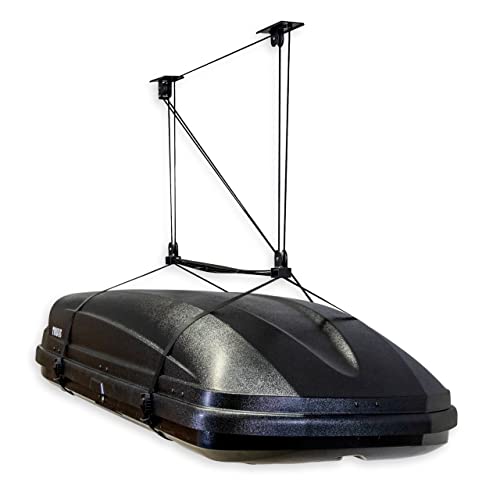
- MAXIMIZE GARAGE STORAGE & ORGANIZATION – Free up valuable floor space by lifting your cargo box overhead with this heavy-duty pulley system for garage use. Perfect for organizing
- COMPLETE GARAGE STORAGE SYSTEM – Includes heavy-duty pulleys, mounting hardware, adjustable loading straps, and center connecting strap to secure your cargo box or rooftop
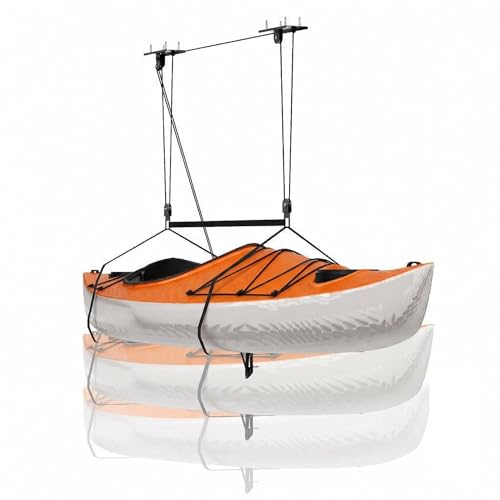
- Reclaim your garage with a smart overhead solution. This Cargo Box Garage Pulley System works with Ceiling Mounted Storage Racks to lift large cargo boxes, bins, and outdoor gear
- Built with heavy‑duty steel brackets and a rugged rope system, this Cargo
The Problem: Storage Requirements Come From Your Box's Maker, Not From Hoist Listings
The supplied hoist listings state nothing about any cargo box's weight, width, length, shell durability, how many people are needed to handle it, or whether storing it on end can damage it. Those points come from your box manufacturer's own instructions, so get them before you choose a storage method.
How a box should be supported, oriented and cared for in storage is set by its maker, not by the hoist listings supplied here. Get your box manufacturer's approved storage method, support and orientation requirements, and its cleaning and drying guidance, and follow those.
An overhead hoist is one option, and only if the complete setup — box, hoist, straps and ceiling structure — is approved for it. Floor storage that meets the box maker's stated support requirements is not ruled out.
Step-by-Step: Getting the Right Removal and Storage Instructions
The supplied hoist records do not authorize any removal, handling, cleaning or storage procedure, so the sequence below is about obtaining and following the instructions that do apply to your equipment.
- Get your cargo box manufacturer's removal and handling instructions. Use the model-specific manual or the maker's support channel, and note the box's weight, the number of people required, and any equipment the maker specifies.
- Get the manufacturer's cleaning, drying, lid-state and storage instructions for your box, including approved orientation and where the shell must be supported. Follow those rather than a generic routine.
- Get the installation and operating instructions for the hoist you buy, and use only the mounting method, hardware and load limits it specifies. The RoakyRoasy Cargo Box Hoist for Garage Ceiling with Metal Pulley System (B0FLVHP4P6) listing states heavy-duty lag screws are included and that step-by-step instructions are provided; confirm what the other systems ship with on their item pages.
- Confirm the whole setup is compatible before you lift anything: the box's approved support points against the hoist's straps, the total load against every hoist, strap, anchor and structural limit, and the raised clearance you actually need. If your ceiling framing's capacity is unknown, get qualified structural advice.
- Arrange the helpers and equipment the instructions require. Do not improvise an overhead lift, and do not work or stand beneath a suspended box.
- Keep the vehicle mounting hardware where the box maker's instructions direct so it is available next season.
StoreYourBoard Cargo Box Pulley System – Heavy-Duty Garage Hoist Lift for Rooftop Carriers — Best for a complete strap and hardware kit
The StoreYourBoard Cargo Box Pulley System listing describes it as a complete system: heavy-duty pulleys, mounting hardware, adjustable loading straps, and a center connecting strap. The supplied listing describes that center connecting strap as helping secure your cargo box or rooftop carrier. It does not state a box length capability, strap spacing, or any stabilizing effect, so treat the center strap as an included component rather than a stated performance benefit.
The seller also says the design is backed by real-world testing — that is the manufacturer's claim about its own process, not an independent verification, and the supplied listing does not state what that testing involved.
Supported strengths: complete strap and hardware kit; joist-orientation flexibility; alloy steel construction.
Limitations to weigh: the supplied listing does not state a raised clearance figure, so if you need the box to tuck as tightly as possible under a low ceiling, that number is not published here. It also does not state a mechanical-advantage ratio.
RoakyRoasy Cargo Box Hoist for Garage Ceiling with Metal Pulley System — Best for a published 5.5" raised clearance
The RoakyRoasy Cargo Box Hoist for Garage Ceiling with Metal Pulley System listing states that when fully raised, the lift sits just 5.5" from the ceiling. That published figure describes the gap between the raised lift and the ceiling. The supplied listing for the RoakyRoasy Cargo Box Hoist for Garage Ceiling with Metal Pulley System does not state how far a strapped cargo box hangs below the ceiling, which would add the box's own height and any strap take-up, so measure your own box against your garage door track and roofline clearance before you buy. A raised-clearance figure is not stated in the supplied listings for the other two hoists, which is an absence in the records we read rather than evidence that those sellers publish none.
Its supplied listing states a 2:1 mechanical advantage, which the seller says cuts the effort to raise or lower the box in half. The listing further specifies 11-gauge steel, all-metal pulleys, 5/16" double-braided polyester ropes, all-metal buckles, and a locking mechanism that grips the rope to prevent slipping. Dual-direction mounting holes allow parallel or perpendicular joist mounting, and heavy-duty lag screws are included.
Supported strengths: the supplied listing states clearance, rope diameter, steel gauge, pulley material, and lift ratio. The seller also offers installation support by message.
Limitations to weigh: capacity is the same 150 lbs as the others. The additional published specifications tell you what the seller commits to in writing; they do not establish predictable lifting, comparative safety, or that this system suits your garage.
Cargo Box Garage Pulley System, Heavy-Duty Overhead Hoist for Rooftop Cargo Boxes & Large Bins — Best for storing odd-shaped gear alongside the box
The framing here is broader. This listing pitches the system for cargo boxes, large bins, totes, sports equipment, tools, and seasonal decor, with adjustable straps described as gripping various sizes of cargo boxes and odd-shaped items. If your overhead zone is going to hold more than just the roof box across the year, that flexibility is the argument.
For B0GQGTXTD4, the published build details are heavy-duty steel brackets and a rugged rope system, and the product title names a dual fixed-point design. The "level, stable, and easy to access" language in this listing describes Ceiling Mounted Storage Racks used alongside the hoist as an anchor point, not the hoist's own dual fixed-point design. Capacity is 150 lbs, ceiling range is 8–10 ft, and the listing credits a mechanical advantage design for reducing lifting effort — though unlike the RoakyRoasy listing, it does not state the ratio.
Supported strengths: explicitly aimed at mixed loads, not only rooftop carriers; steel brackets and adjustable straps.
Limitations to weigh: the listing repeatedly frames the product as working with or paired with ceiling mounted storage racks, so read the item page carefully to confirm exactly what ships in the box before you plan your install. No raised-clearance figure and no joist-orientation detail are stated in the supplied listing.
Tools You'll Need Beyond the Hoist
Tool, ladder, padding and helper requirements depend on the exact approved installation and on your box maker's handling instructions, and no generic list establishes a safe solo mount or lift. Obtain the tool and structural requirements from the installation instructions for the system you choose, and follow them.
On included hardware, the supplied listing for the RoakyRoasy Cargo Box Hoist for Garage Ceiling with Metal Pulley System (B0FLVHP4P6) states that heavy-duty lag screws are included. The supplied listing for the StoreYourBoard Cargo Box Pulley System (B0BVBT5171) states it includes heavy-duty pulleys, mounting hardware, adjustable loading straps, and a center connecting strap, without specifying the fastener type. The supplied listing for B0GQGTXTD4 does not state what mounting hardware is included.
Tips for Best Results
Install exactly as the hoist's own instructions specify, and confirm your structure can carry the load. Every one of these systems anchors overhead, and the anchor is the entire safety story. Knowing which way your joists run does not tell you what the framing can carry, nor what fastener size, spacing or attachment method is correct — those come from the hoist's installation instructions, and from qualified structural advice if your ceiling's capacity is unknown. The StoreYourBoard Cargo Box Pulley System listing says it installs parallel or perpendicular to joists. The RoakyRoasy Cargo Box Hoist for Garage Ceiling with Metal Pulley System listing cites dual-direction mounting holes for parallel or perpendicular joist mounting and includes heavy-duty lag screws. The supplied listing for B0GQGTXTD4 does not state a mounting method or hardware, so confirm on the item page how it anchors before you install.
Check the load against the rating, not against how it feels. Each seller states its own capacity in its supplied listing. Weigh or look up your actual box and check the total load against every hoist, strap, anchor and structural limit as each one defines it, and confirm the box's support compatibility and the clearance you need when raised. For the StoreYourBoard Cargo Box Pulley System (B0BVBT5171), the supplied listing bullets state it supports up to 150 lbs and is designed to fit 8–10 ft garage ceilings. For the RoakyRoasy Cargo Box Hoist for Garage Ceiling with Metal Pulley System (B0FLVHP4P6), the supplied listing bullets state it supports up to 150 lbs and describe it as perfect for 8-10 ft garage ceilings. The Cargo Box Garage Pulley System (B0GQGTXTD4) listing states a 150 lb capacity and 8–10 ft garage ceilings. Those seller-stated figures do not by themselves establish a safe fit for your box, your ceiling structure or your clearance.
Follow your box maker's care instructions on cleaning, drying and lid state. The supplied records do not establish a universal lid state or care routine for any box.
Keep the vehicle mounting hardware where your box maker's instructions direct.
Inspect the hoist on the schedule and by the method its own instructions specify, including rope, straps and pulleys. The supplied listings do not state an inspection interval or procedure. The CPSC maintains recalls and safety notices for consumer products, which is worth a check if anything about a component looks off, though it does not supply installation or maintenance instructions (S1).
Common Mistakes to Avoid
- Hoisting a loaded box. Follow the load limits and operating instructions for your hoist and box.
- Storing the box in a way its maker does not approve. Check the manufacturer's stated support and orientation requirements for long-term storage.
- Deviating from the hoist's own installation instructions. Use the mounting pattern, orientation and hardware that your system's instructions specify. Both the StoreYourBoard Cargo Box Pulley System (B0BVBT5171) and the RoakyRoasy Cargo Box Hoist for Garage Ceiling with Metal Pulley System (B0FLVHP4P6) listings describe parallel or perpendicular joist mounting as supported configurations.
- Skipping the manufacturer's cleaning and drying steps. Use the box maker's stated care procedure before storage.
- Skipping the ceiling measurement. Check the ceiling range each seller states for its own system against your garage. If your garage falls outside the range stated for the system you choose, it is not the right product.
- Assuming rated capacity equals a safe anchor. The hoist's rating describes the hoist. It does not tell you what your particular ceiling framing can carry.
How We Research
This site does not do product research. For this guide, product facts come from two source types only: Amazon Creators API verified product records and the product listing feature bullets for each ASIN, all retrieved 2026-09-06. We read each listing's own bullets closely, compared the specifications the sellers actually publish, and flagged where a figure one seller states is simply absent from another's listing rather than assuming it is worse or zero.
Final Verdict
If the deciding factor for you is how much the seller states in writing, the RoakyRoasy Cargo Box Hoist for Garage Ceiling with Metal Pulley System publishes the most detail in its supplied listing: a 5.5" raised clearance, a 2:1 mechanical advantage, 11-gauge steel, and 5/16" double-braided polyester rope. Those disclosures do not make it a default pick for most garages — choose only after you have confirmed compatibility between your box, the hoist, your ceiling structure and your clearance, and note the listing does not state how far a loaded box hangs below the ceiling.
Choose the StoreYourBoard Cargo Box Pulley System instead of that pick if the center connecting strap and complete included hardware kit are what you value. Choose the Cargo Box Garage Pulley System if your overhead zone will rotate through bins, totes, and sports gear as well as the roof box, since its listing is written around that mixed-use case.
Honestly, the biggest win here is not which hoist you pick. It is getting the box off the floor at all.
Related Resources
- Roof cargo box buying guide
- Crossbar compatibility explained
- Garage overhead storage planning
- CPSC consumer product safety information (S1)
- USA.gov consumer protection resources (S2)
Sources & Methodology
Nobody here lifted, mounted, or load-tested any of these hoists, and this site runs no lab. What went into this guide was a close reading of each product's Amazon Creators API verified product record and its published listing feature bullets, retrieved 2026-09-06, with attention to which specifications each seller commits to in writing — clearance, steel gauge, rope diameter, lift ratio, included hardware — and which they leave unstated. For ceiling hoists that is genuinely useful, because the buying decision turns on published numbers you can measure your own garage against rather than on feel. It will not tell you how smoothly a given rope runs after two seasons, and no amount of spec reading substitutes for confirming your own ceiling framing can carry the load.