As an Amazon Associate this site earns from qualifying purchases.
Quick Picks
| Product | When to investigate it | Key published spec | Link |
|---|---|---|---|
| INNO WEDGE660 White 11 cu ft | A different box, after confirming the exact vehicle, rack, mounting and hatch-clearance requirements | Verified product title states compatibility with Aero and square bars, while a listing bullet also claims round and most factory racks — confirm bar profile with the manufacturer; track design listed as allowing fore/aft adjustment for hatch clearance | Check Price on Amazon |
| ATNVIDSG Roof Box U-Bolt Clamps/Roof Rack Clamps | General-purpose roof rack clamps, only where the box and rack manufacturers approve these exact parts | 85 mm inside width, 90 mm outside; 8 lock nuts included | Check Price on Amazon |
| CursorTech 64" x 39" x 6" Roof Basket Heavy Duty Cargo Rack Basket 300lbs | An open carrier option, after confirming the load dimensions, approved securement and complete vehicle/rack fit | Rated to 300 lbs dynamic load; mounts to crossbars up to 1.3 in thick and 4.3 in wide | Check Price on Amazon |
Disclosure: We earn a small commission from qualifying Amazon purchases at no extra cost to you.
Last Updated: September 2026
If your cargo box is shifting on the roof rack, possible causes include mounting hardware that was not installed to the manufacturer's specification, a crossbar spread outside the range the box's mounts are approved for, or a clamp whose jaw does not match the bar it is gripping. The supplied listings do not establish how often each occurs. Check fitment against the published specifications and follow the box, rack and vehicle manufacturers' installation instructions; do not drive while movement or an unresolved mounting fault remains.
This site does not do product research. This guide identifies the fit information and manufacturer instructions to obtain, then compares published product specifications. These listings cannot diagnose an individual installation or establish that buying a different product will resolve it.
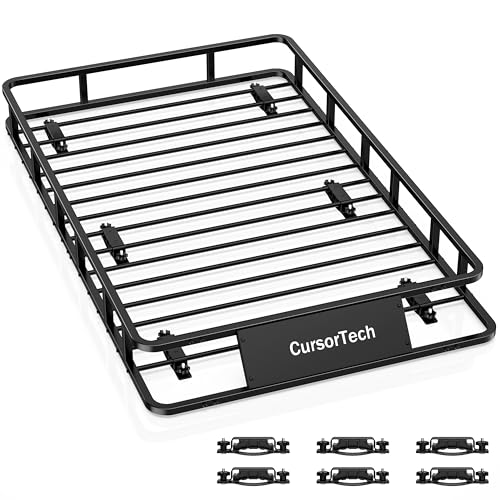
- 300LBS HEAVY DUTY LOAD CAPACITY: Built with heavy duty steel construction, the CursorTech roof rack basket supports up to 300 lbs dynamic weight, providing a reliable rooftop
- EXTRA LARGE 64" STORAGE SPACE: The 64" x 39" roof rack cargo basket offers expanded storage capacity, allowing you to carry bulky items like camping gear, coolers, luggage and
The Problem: Why Roof Boxes Move
Movement or new noise calls for checking the exact installation. The supplied records do not establish a universal clamp count, contact pattern or diagnostic sound. Use the vehicle, rack and carrier instructions to identify the approved mounting system and inspection procedure; ask the manufacturer or an authorized installer to resolve a fault that those instructions do not explain.
Failure modes to consider, without any claim about how common each is:
- Hardware not installed to specification. A subjective impression that a nut or knob feels tight does not establish compliance with the equipment instructions. Check the exact approved method and specified limits.
- Wrong crossbar spread. The box's mounting slots have a usable range set by the manufacturer. Bars outside that range may leave a clamp positioned where the manufacturer does not permit.
- Clamp-to-bar mismatch. A U-bolt sized for one bar profile may not seat correctly on another.
Step-by-Step: Diagnose and Fix It
- Stop safely before investigating a moving carrier. Follow the vehicle and carrier instructions for parking, access and any required unloading. Do not continue driving with an unresolved mounting fault.
- Identify the exact equipment. Record the vehicle, rack, carrier and mounting-hardware models so that the correct fitting and service instructions can be obtained.
- Check the approved mounting configuration. Compare the installed hardware and permitted mounting positions with those instructions. Do not substitute a generic corner-push or crossbar-shaking test for the manufacturer's inspection.
- Use the specified inspection criteria. The listings supply no universal pad-compression target or tightening force. If the equipment cannot be verified against its instructions, have the manufacturer or an authorized installer assess it.
- Measure your crossbar spread (center to center) and your bar cross-section (width and thickness) with a tape. Write both numbers down — they are the first figures to compare against the published specifications below.
- Obtain and follow the manufacturer-approved installation instructions for your exact box, rack and mounts, including any specified tightening sequence and torque. The supplied listings state no tightening procedure or torque value, so do not substitute a generic one.
- Follow the inspection schedule in your box, rack and vehicle instructions. The supplied listings state no inspection interval. Stop safely and inspect if new movement or noise appears, and do not drive while a mounting fault is unresolved.
- Confirm rear hatch clearance with the box in its final position before you call the job done.
Tools and Products You'll Need
Measurements can help you compare the published fit limits, but first obtain the instructions and approved hardware list for the existing setup. The three products below are shopping options to investigate after those requirements are established, not proven repairs for a moving carrier.
ATNVIDSG Roof Box U-Bolt Clamps/Roof Rack Clamps — Universal clamps with published bracket dimensions
If your box's own mounting hardware is worn, stripped or missing, obtain the replacement parts the box manufacturer approves for it; the supplied facts do not establish that this or any third-party kit is an approved substitute for a box's specified mounting hardware. Use these clamps only for an application where the box and rack manufacturers approve these exact parts and the full installation. The listing states an inner width of 85 mm (3.35 in) and an outer width of 90 mm (3.54 in), and says the brackets accommodate luggage racks up to approximately 40 mm (1.57 in) thick [S4]. Those two numbers are a necessary starting point, not the whole purchase decision. Measure your bar; if it is wider than 85 mm across or thicker than about 40 mm, this kit is the wrong size and no amount of tightening will change that. Falling inside those dimensions does not by itself prove fit: the supplied listing for the ATNVIDSG Roof Box U-Bolt Clamps states nothing about which bar profiles the U-bolt jaws seat against or whether the kit matches a given roof box's mounting slots, and the listing itself warns you to check that your vehicle size is suitable before ordering [S4].
The set is listed as 4 stainless steel U-bolts, 4 rubber washers, 4 back plates, 8 lock nuts, 2 bandages and 1 hole sealing sticker, installed without drilling [S4]. The supplied listing for the ATNVIDSG Roof Box U-Bolt Clamps does not state how those nuts are arranged on the U-bolt threads and describes no anti-vibration nut configuration, so fit the hardware the way the manufacturer directs.
The seller describes the rubber gasket and plastic backing plate as protecting the car from scratches and increasing friction [S4]. That seller description does not specify an installation force or a pad-compression target. Follow the approved hardware instructions without using the appearance of the pad as a tightening test.
One honest caveat. The listing itself carries a prominent warning to check your vehicle size before ordering [S4]. Check the listed dimensions and obtain confirmation of the complete approved application; measuring the bar alone cannot establish it.
INNO WEDGE660 White 11 cu ft — Best for a box on Aero or square bars that needs fore/aft adjustment
If the existing box cannot be installed in an approved configuration, investigate alternatives using the full fit requirements. For this box, the supplied record describes bar compatibility in two places. The verified product title for the INNO WEDGE660 White 11 cu ft (ASIN B078ZSBHNC) states it is "Compatible with Aero & Square Bars", while a listing feature bullet says it fits Aero, square, round and most factory racks [S3]. The title naming Aero and square bars does not by itself contradict the bullet's broader list; both are the seller's own statements. Confirm complete fit for your exact vehicle, rack and mounting configuration with the manufacturer before buying.
The track design is described as making it simple to adjust the box forward or back for hatch clearance, and as providing a better seal against bad weather [S3]. That fore/aft travel is described for hatch clearance; the supplied listing does not state that it changes the crossbar spacing the mounts accept, so it is not a stated fix for a spread mismatch. Installation is listed as tool free [S3]. The supplied listing does not state whether clamp tightness can be verified or restored by hand once the box is mounted, so plan on checking the hardware the way the manufacturer directs.
Other published details: dual side opening for access from either side, a safety lock that the listing describes as allowing you to pull the keys out once the box has been closed all the way, and a limited lifetime warranty [S3]. The supplied listing does not state that the keys are captured when the box is not fully latched, so do not treat key removal alone as proof of latching; follow the exact manufacturer closure and pre-drive checks.
What the supplied listing information does not state: exterior dimensions, weight, load rating, or the crossbar spread range the mounts accept. Before buying, confirm the complete approved fit, load limits, installed clearances and mounting configuration for your vehicle and rack.
CursorTech 64" x 39" x 6" Roof Basket Heavy Duty Cargo Rack Basket 300lbs — Best for open-basket loads with published crossbar limits
The supplied record does not diagnose basket movement or compare it with box movement. Its stated crossbar limits are: the listing states it mounts to most crossbars with a maximum crossbar thickness of 1.3 inches and a maximum width of 4.3 inches [S5]. Compare both of those figures against your own tape reading: a bar thicker than 1.3 inches or wider than 4.3 inches falls outside the published envelope for this basket. Meeting both limits does not establish complete fit — the supplied listing states no crossbar spread range or vehicle-fit data for the CursorTech 64" x 39" x 6" Roof Basket.
Capacity is listed at 300 lbs dynamic weight over a 64" x 39" x 6" steel frame with a powder-coated, rust-resistant finish [S5]. Distribute and secure the load as the basket, rack and vehicle manufacturers direct, and stay within every vehicle, rack, mounting and carrier limit, counting the weight of the equipment as well as the cargo. Load distribution alone does not prevent mounts from loosening or establish a permissible load.
The listing also credits the wind fairing with reducing wind resistance and driving noise at highway speeds [S5] — worth flagging as a manufacturer claim rather than an independently verified figure, since no decibel number is published in the supplied record.
Tradeoff to be clear about: a basket is open. Use the basket, rack and vehicle manufacturers' approved mounting and cargo-restraint methods. The supplied listing does not state that a net or cover is included; any additional equipment must suit the intended load and approved instructions.
Tips for Best Results
- Compare crossbar measurements with the exact manufacturer-defined dimensions, then confirm the remaining fit, mounting-position and clearance requirements. A match on a few measurements is not complete approval.
- Follow the carrier, rack and vehicle instructions for load placement and securement, and satisfy each applicable limit as defined, including the weight of equipment and cargo where required.
- Do not judge clamp force by how compressed a rubber pad looks or by shoving a corner. Obtain and follow the exact box, rack and mount instructions for tightening.
- Follow the manufacturer's inspection schedule for your box and rack.
- If you tow or park in garages, note the added height somewhere you will see it. Before any automatic car wash, check the carrier, vehicle and car-wash instructions to confirm the wash permits an installed roof carrier; knowing the height does not establish that it does.
Common Mistakes to Avoid
- Ignoring the manufacturer's specified tightening sequence and torque. The supplied listings state none, so get them from the manufacturer.
- Assuming universal means your car. The U-bolt kit publishes an 85 mm inside width [S4].
- Treating pad appearance as an installation test. The seller claims scratch protection and added friction [S4], but supplies no pad-compression or tightening specification.
- Ignoring a rack fault. Have the complete rack and carrier installation checked using the relevant instructions; replacing the carrier does not establish that a rack fault has been resolved.
- Skipping the manufacturer's inspection schedule.
How We Research
We read manufacturer and retailer specifications closely and reason from them. For this page, that means Amazon Creators API verified product records and the product listing feature bullets for each ASIN, retrieved 2026-09-06. Where a listing does not state a figure — spread range, weight, decibel level — we say so rather than estimating. No physical testing, measuring or installation was performed for this article.
Related Resources
- How to measure crossbar spread
- Roof box vs cargo basket
- Reducing roof rack wind noise
- For general consumer product safety information and recall notices, see the U.S. Consumer Product Safety Commission and USA.gov consumer protection.
Final Verdict
Fix the diagnosis before the purchase. If your box's mounting hardware is worn, get the replacement parts its manufacturer approves. The ATNVIDSG Roof Box U-Bolt Clamps/Roof Rack Clamps publish an 85 mm inside width and accommodate racks up to approximately 40 mm thick [S4]; the supplied facts state no price, no load rating and no compatibility with any specific box's mounting interface, so use them only where the box and rack manufacturers approve these exact parts and the full installation. If the box itself will not sit right on your bar profile or clear your hatch, the INNO WEDGE660 White 11 cu ft is an alternative to evaluate against the complete approved fit requirements: its verified product title states compatibility with Aero and square bars, while a listing bullet also claims round and most factory racks, so confirm the full vehicle, rack and mounting compatibility with the manufacturer; its track is listed as adjusting fore and aft for hatch clearance [S3]. Its accepted crossbar spread range is not stated in the supplied listing. And if you are hauling awkward, bulky gear rather than luggage, the CursorTech 64" x 39" x 6" Roof Basket lists a maximum crossbar thickness of 1.3 inches and a maximum width of 4.3 inches, with a 300 lbs dynamic rating [S5]. Its accepted crossbar spread range is not stated in the supplied listing. Obtain it and confirm all mounting, clearance, cargo-restraint and applicable load requirements before selecting the basket. A listed carrier rating alone is not your vehicle's permissible cargo allowance.
Resolve any rack fault through its approved service procedure before using a carrier. The supplied listings do not establish a repair for a loose rack-to-vehicle attachment.
Frequently Asked Questions
How tight should roof box mounting hardware be? As specified by the manufacturer of your box, rack and mounts. The supplied listings state no torque value or tightening method, and appearance of the rubber pad or a shove at one corner is not a substitute for the specified tightening. The ATNVIDSG Roof Box U-Bolt Clamps kit is listed as including 8 lock nuts along with its 4 U-bolts [S4]; the listing does not describe any particular nut arrangement for resisting vibration, so install the hardware as the manufacturer directs.
My roof box does not fit my crossbar spread — what now? Measure your spread center to center first. If your bars are adjustable, any new position must stay within the mounting positions your vehicle and rack manufacturers permit as well as within the box's stated spacing range; fitting the box alone does not authorize moving the bars. If they are fixed factory bars, you need a box whose mounts are rated for that spread. The supplied listing for the INNO WEDGE660 White 11 cu ft does not state the crossbar spread range its mounts accept, so check that figure with the manufacturer before buying; its track design is described only as making it simple to adjust the box forward or back for hatch clearance [S3].
Will universal U-bolt clamps fit any roof rack? No. The ATNVIDSG clamps publish an 85 mm (3.35 in) inside width, a 90 mm (3.54 in) outside width, and accommodate racks up to approximately 40 mm (1.57 in) thick [S4]. A bar outside those published limits is outside the stated size envelope. Falling within them still does not establish the approved bar profile, mounting-interface fit, hardware retention or compatibility with your exact box and rack.
Does a cargo basket wobble more than a hard box? The supplied listings do not state the clamping hardware each carrier uses, so they do not support a stability comparison between the two. Both enclosed and open carriers need the cargo secured by the methods their manufacturers approve; enclosure does not replace cargo restraint. The CursorTech basket's listing states a 300 lbs dynamic capacity and crossbar limits of 1.3 in thickness and 4.3 in width [S5].
Can I stop wind noise by tightening the box? The sound alone does not establish whether the cause is airflow, mounting or something else. Inspect according to the exact carrier and rack instructions, and use only the specified tightening procedure; additional tightening is not a general noise remedy. The CursorTech basket's listing credits its wind fairing with reducing wind resistance and driving noise at highway speeds [S5], though no measured noise figure is published in the supplied record.
How often should I re-check the hardware? Follow the inspection schedule in your box, rack and vehicle manufacturers' instructions; the supplied listings state no interval. If new movement or noise appears, stop safely and inspect before continuing.
Sources & Methodology
Nothing on this page was bolted to a roof, driven, or measured by anyone here — this site runs no test rig and does not claim one. What we did instead was read each product's Amazon Creators API verified product record and its published listing feature bullets, retrieved 2026-09-06, and compared the published specifications each seller states: clamp jaw widths, maximum bar thickness, load ratings and adjustment range. Those figures are geometry and rating limits, not proof that a mount will hold. Comparing your own measurements against a published envelope is a first filter that identifies what still has to be confirmed with the manufacturer. It is only a first filter, though: the supplied listings leave crossbar spread ranges and vehicle fit unstated, so confirm those with the manufacturer.